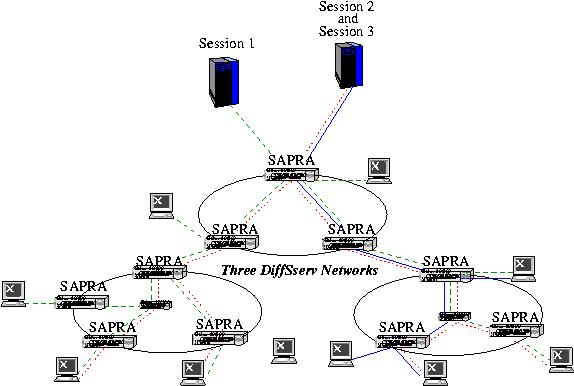
We proposed in a protocol named
Session-Aware Popularity-based
Resource Allocation (
SAPRA
) that increases the number of receivers with good reception quality.
To achieve this, SAPRA provides inter-session fairness inside each network
service by assigning more bandwidth to sessions with higher audience size,
and intra-session fairness, by assigning to each layer a drop precedence
that matches its importance. To achieve its goal, SAPRA adds agents and
markers to edge routers. Agents manage sessions to provide inter-session
fairness; markers deal with layers, providing intra-session fairness. In
the spirit of the DS model, agents and markers are placed only in edge routers,
since they do not need access to the aggregate traffic of each service. SAPRA
manages sessions rather than managing multicast groups without concern about
their semantic relationship, since hiding session information from edge
routers results in intra-session unfairness, higher quality oscillations
and lower quality for all receivers
SAPRA also includes a punishment function and a resource utilization
maximization function. The former increases the drop percentage of high-rate
sessions, motivating sessions to adapt to the network capacity high-rate
sessions are sessions with a rate above their fair share during periods
of congestion. The latter avoids waste of resources when sessions are not
using their entire.
Simulations show that agents and markers fairly distributes queue resources
on edge routers increasing the number of receivers with good quality and
approximates the efficiency of other more complex fair allocation schemes.
Theoretical analysis and simulations also show that the protocol has
small bandwidth overhead, is efficient in providing agents with accurate
information about sessions, and supplies receivers with timely reports
about the quality of their sessions.